+ 09.02.09
The T5 Advantage
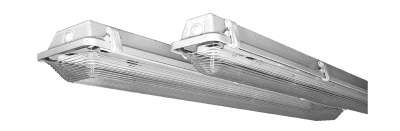
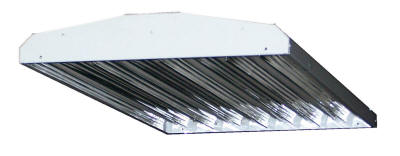
For many years, the standard for lighting high bay applications such as riding arenas, barns, warehouses, industrial and manufacturing facilities has been the 400-Watt Metal Halide fixture. Advances in ballast technology and the introduction of the T5 High Output Linear Fluorescent lamp have led to many new luminaries that are targeted specifically for high bay applications. The following article details the many benefits that the T5 HO high bay fixture offers over traditional 400-Watt Metal Halide high bays.
Energy Efficiency
With the rising cost of energy, facilities and operations managers are
doing everything possible to lower total power consumption. One of the
main reasons many companies turn to T5 HO high bay fixtures when
retrofitting their lighting system is the T5’s ability to provide better
light while consuming much less energy than traditional 400 Watt metal
halide fixtures. T5 HO fluorescent lamps consume 54 Watts of power and
output up to 5,000 lumens per lamp. Typical 4-lamp fixtures consume a
total of 231 Watts vs. the 454 Watts that a 400-Watt Metal Halide
consumes. In most cases, maintained foot candle readings are almost
always better per energy dollars spent.
|
Light Source |
Conventional |
|
Low-pressure sodium |
165 |
|
5000K T5 fluorescent |
104 |
|
4100K T8 fluorescent |
90 |
|
Clear metal halide |
85 |
|
5000K pure triphosphor fluorescent |
70 |
|
3500K triphosphor fluorescent |
69 |
|
50 Watt high-pressure sodium |
65 |
|
2900K warm white fluorescent |
65 |
|
Daylight fluorescent |
55 |
|
35 Watt high-pressure sodium |
55 |
|
Deluxe mercury vapor |
40 |
|
Standard incandescent |
15 |
|
Tungsten halogen |
22 |
Lumen Maintenance
All lamps have some depreciation of the light output as they age. T5
fluorescent lamps only lose 5-6% of their lumen output between the rated
initial spec and the mean spec. By contrast, Metal Halide lamps can have
as much as 35% depreciation of lumen output during the same time period.
This difference becomes more pronounced as the lamps continue to age.
No Strike/Re-strike Delay
HID lamps require some time to turn on. This is called the strike time.
If the lamps have been on for some time and power is cut off, they would
also need time to re-strike. Fluorescent lamps however, turn back on
instantly without affecting the rated life of the lamp. This allows them
to be used with occupancy sensors, photo cells and advanced lighting
control systems that can further reduce operating costs by turning off
the fixture when not in use. Modern T5 ballasts also allow for multiple
switch legs that can individually control the pairs of lamps in a
fixture. These can be wired into separate circuits or control systems to
allow for dimming options.
More Usable Light
A linear fluorescent lamp shines light out radially in every direction
from the center of the tube. Light that is cast out of the top of the
lamp towards the fixture bounces off of the reflector and comes back
towards the work plane. For larger T12 and T8 lamps, the size of the
tube prevents most of this light from reaching the work plane because it
bounces back to the tube. Since T5 tubes are extremely thin (only 5/8”
diameter), more light can exit the fixture. This leads to more efficient
fixtures and less shadows.
Better Color Rendition
Color rendition index (CRI) is the measure of the ability of a light
source to reproduce the colors of various objects faithfully in
comparison with an ideal or natural light source. T5 lamps have a CRI of
85 while metal halide lamps, on the other hand, have a CRI of 65-70. The
lower CRI negatively impacts visual acuity and can strain the eye. The
following table provides a comparison of the CRI for several light
sources.
|
Lamp Type |
CRI |
|
T5 Fluorescent |
85-98 |
|
T8 Fluorescent |
75-98 |
|
High color-rendering metal halide |
80-93 |
|
White high-pressure sodium |
60-85 |
|
Standard metal halide |
60-70 |
|
Pulse-start metal halide |
65-70 |
|
High-pressure sodium |
27 |
|
Low-pressure sodium |
5 |
Color Temperature
Modern fluorescent lamps are available in a wide variety of color
temperatures. These range from 3000K to 6500K. Specialty lamps extend
the spectrum even more to suit specific purposes.
Consistent Color Output
Fluorescent lamps maintain a more uniform color output throughout their
life. Metal Halide or other HID sources can have their output color
shift as the lamps age.